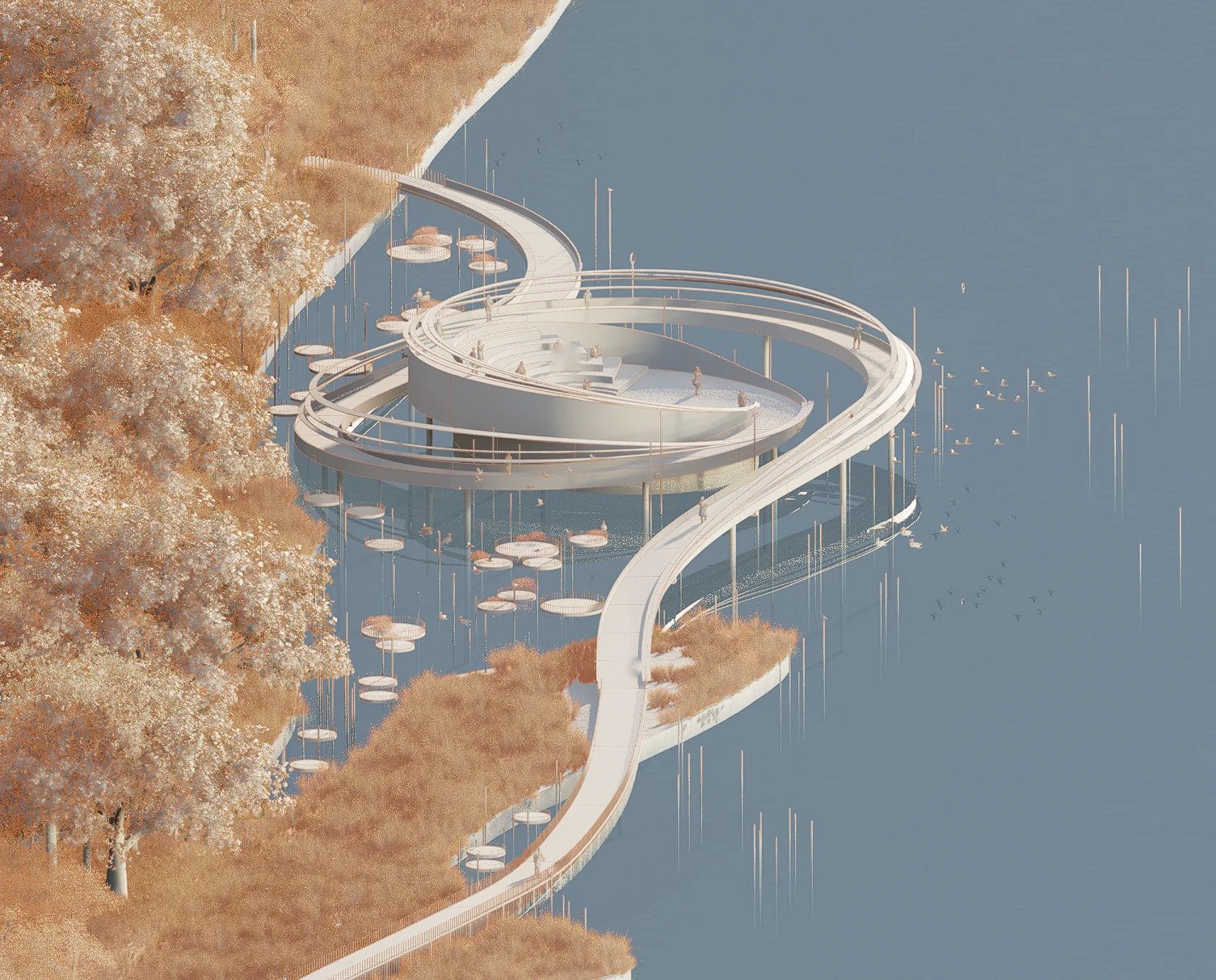
A bird observation pavilion and walking route rising above the reeds and the lake in La Albufera Natural Park, Valencia.
The pavilion is positioned as a deliberate ecological threshold, serving as a buffer zone between the La Albufera Reserve Area and the surrounding high-density pedestrian activity. Strategically located at the intersection of pedestrian, cycling and service axes, the project aims to integrate with the existing network of paths established by the Valencia Municipality. Consequently, it transcends its function as a mere bird observatory, evolving into a landmark that enhances both the local and touristic experience of the region. By reimagining the pavilion not solely as a bird-watching station but as an installation that catalyses local activity, we have facilitated access via both land — through a path designed for pedestrians and cyclists — and water, via a boat pier.
The design avoids imposing direct structural loads on the sensitive fauna of the reserve. Elevated above the reeds and the lake, the observation point leaves the existing marshland undisturbed. In alignment with the mission of the adjacent Bird Rehabilitation Center, the project incorporates pollinator hubs and native flora, actively contributing to the wildlife feeding cycle. These pollinator platforms, situated along the path, allow visitors to observe not only birds and lake vistas but also the diverse species that define the local biodiversity.
Vertical platforms along the route assist visitors in observing and photographing birdlife more closely. This proposed route creates a seamless pedestrian continuity with the Racó de l’Olla Visitor Center and the botanical park axes. By engaging with the shoreline, the project establishes a balanced, low-intensity public gathering space suitable for traditional boat tours and sunset viewing. Rather than replicating the technical functions or increasing the load of the existing bird observation tower and research center at the Nature Reserve, the project gently guides visitors toward experiential viewing and walking routes along the lake perimeter.
The structure is sited in an area with minimal rice cultivation, aiming to offer an enhanced experience in a zone with higher bird activity (within the reserve area) while minimising interference with the region’s ecological and commercial fabric.
The pedestrian and cycling route providing access to the structure is positioned to minimise environmental impact, discreetly weaving through the vast reed beds along the path. In areas where the reeds rise, the path is elevated on steel columns, returning to ground level thereafter.
For the pavilion’s structure, we designed openings that provide visual experiences based on calculations of annual water level fluctuations, optimal vantage points and areas of high avian density. Gently elevating above the lake level, the structure symbolises a bird’s nest that blends harmoniously with the background trees when viewed from the water. Segmented eaves along the walkway provide shading for pedestrians and perching surfaces for birds, while concealing observers from the wildlife to facilitate photography and discreet observation. The central amphitheatre is designed to accommodate educational events, gatherings and leisure activities; the convergence of the two ascending paths at this central point reinforces the necessity of this communal space.
The structure is supported by steel elements embedded into the lakebed. Steel was selected for its ease of assembly, lightweight properties and fabrication efficiency — the most appropriate choice to minimise the structural impact on the site’s existing ecosystem.
We use cookies to improve the site and measure our ads. Privacy

